The question sounds natural in your head. Then you try to write it in a second language, the right word hides, and what you finally send is "How are you?" Sound familiar?
Language gaps are common in written conversation, and they shrink fast when the topic does some of the work. On Asiatalks, we put together topics, sample lines, and writing habits that carry a conversation even when vocabulary runs short, whether the gap is yours, theirs, or shared.
Why the Topic Does Half the Work
Abstract questions ask for long sentences. "What is your philosophy about success?" needs careful grammar and a rich vocabulary. A concrete question needs neither. "What did you eat today?" can be answered in four words, and the answer hands you something specific to ask about next.
That is why choosing a topic matters so much in any chat on Asiatalks. Concrete topics keep sentences short, and short sentences are easier to write, easier to read, and easier to look up when a word is new.
Three habits make any topic work harder on Asiatalks:
-
Pick things you can see, taste, or hear
-
Ask about one detail instead of a whole life story
-
Let each answer choose your next question
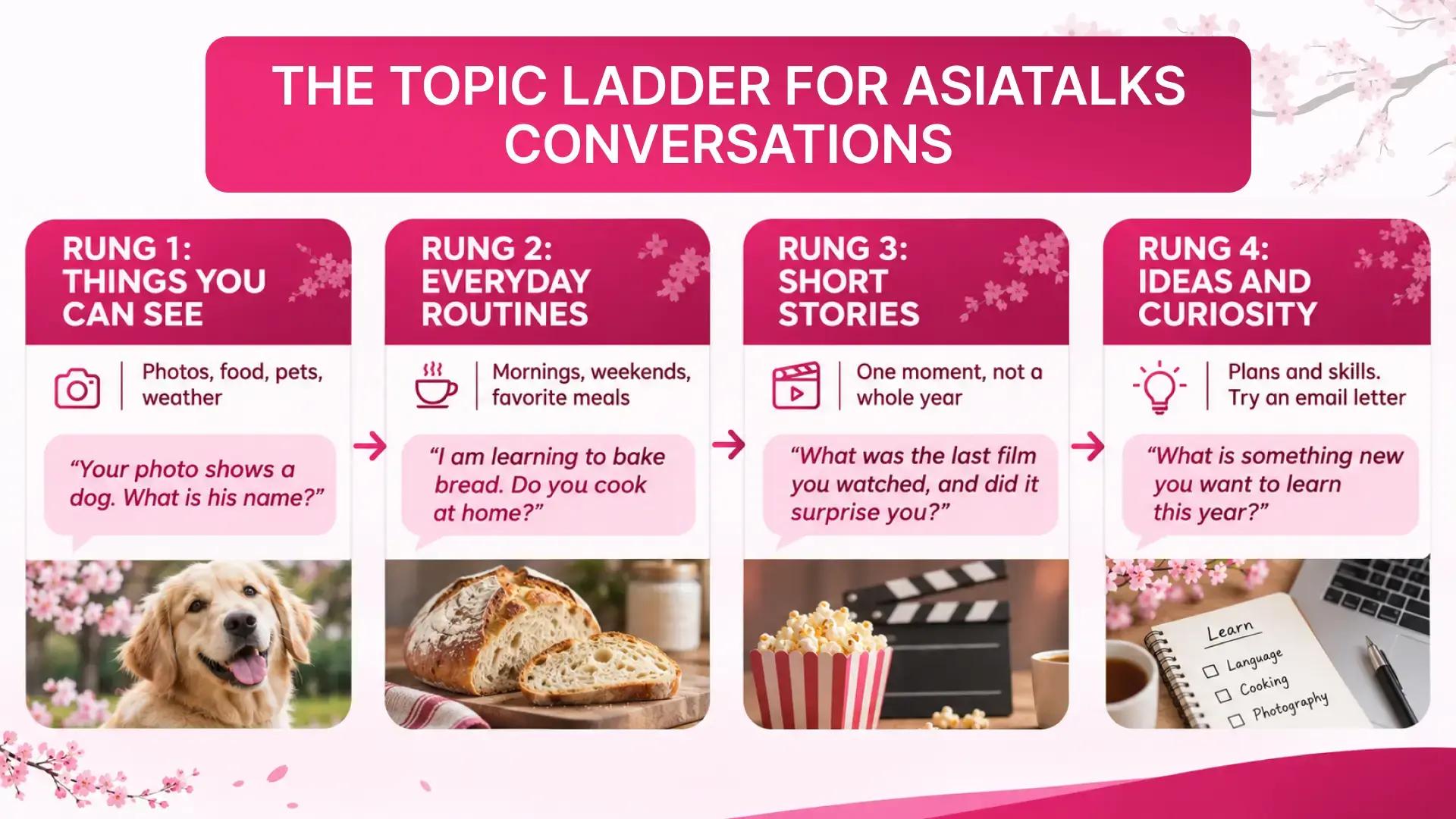
The Topic Ladder for Asiatalks Conversations
Think of topics as a ladder. Start at the bottom rung, where words are common, and answers are short, and climb only when the conversation feels ready. Each rung below comes with lines you can adapt for a first message or a reply on Asiatalks.
Rung 1: Things You Can See
Photos, food, pets, weather, and places give both of you something to point at. On Asiatalks, a profile photo is already a ready-made first topic.
-
"Your photo shows a dog. What is his name?"
-
"That soup looks good. What is in it?"
-
"It is raining here today. What is the weather like for you?"
Photo sharing inside a conversation on Asiatalks helps here too. A picture of your breakfast says more than a paragraph of adjectives.
Rung 2: Everyday Routines
Mornings, weekends, favorite meals, and small habits are easy to describe in the simple present tense. Everyone has an answer, and nobody needs special words.
-
"What do you usually drink in the morning?"
-
"How do you spend a quiet Sunday?"
-
"I am learning to bake bread. Do you cook at home?"
The third line shares a small fact before asking. That one extra sentence gives the other person on Asiatalks a second thing to react to.
Rung 3: Short Stories
Stories need a few more words, and this is where Asiatalks conversations start to feel personal. A small story is still short, so ask about one moment, not a whole year.
-
"What was the last film you watched, and did it surprise you?"
-
"Which song gives you energy when you are tired?"
-
"Tell me about a small trip you remember well."
Rung 4: Ideas and Curiosity
Plans, skills, and questions about the future take longer to write, so save them for when both of you are comfortable.
-
"What is something new you want to learn this year?"
-
"With an open weekend, what would you cook, build, or read?"
-
"Which skill would you like to teach someone?"
Email letters on Asiatalks suit this rung well, because they give you room to write slowly, reread, and fix a sentence before you send it.
How to Pick Your Starting Rung
Let the Asiatalks profile in front of you decide:
-
Pet, meal, or view in the photo? Start on rung 1
-
Rung 2 fits a bio that mentions a weekend habit
-
A film, song, or trip mentioned in the bio suits rung 3, where a short story fits naturally
-
Plans or a skill being learned? Rung 4, ideally in a longer letter
Most Asiatalks conversations touch two or three rungs before they settle, and moving up and down is normal, since a return to rung 1 after a heavy topic works as a breather for both people.
A Conversation in Five Lines
Sam and Jo are made-up Asiatalks members. Their chat starts on rung 1 and takes a small detour.
-
Sam: “Hi Jo, cute dog in your photo. What’s his name?”
-
Jo: “Biscuit. He’s three, and mud is basically his hobby.”
-
Sam: “Ha, good hobby. It rains here today. Is Biscuit happy?”
-
Jo: “Sunny here, sadly for him. I baked bread this morning, and it came out flat.”
-
Sam: “Flat? Sorry, I don’t know this word for bread.”
-
Jo: “It didn’t rise. More pancake than loaf.”
-
Sam: “Ah, pancake bread! Mine usually comes out too tall.”
Look at line five. Sam hit an unknown word and said so, politely, in eight words. Jo answered with a picture instead of a definition: pancake. Two lines fixed it, and by line seven, Sam was already joking about tall bread.
Writing Habits That Keep Messages Clear
You can write a warm message with ordinary words. These habits help on Asiatalks and anywhere else:
-
One idea per sentence
-
Common words over rare ones, such as "use" in place of "utilize"
-
Present tense whenever the story allows it
-
Plain words instead of idioms, since a phrase like "a piece of cake" may puzzle a reader, while "easy" will not
-
Numbers, names, and places, which are easy to recognize
-
One question at the end, so the other person knows exactly what to answer
Not sure about a word while you write on Asiatalks? Run it through a translation app first. Apps get things wrong now and then, so treat the app as a dictionary: look the word up, then write the sentence yourself. Messages tend to sound warmer when they sound like you, rough edges included. Read the other person's message twice before you reply on Asiatalks: once for the words you know, once for the question hiding inside.
A notes app can hold a few go-to phrases for Asiatalks chats, like a greeting or a polite "could you write a bit slower?" Paste one in when you need it, then add a detail only this chat has, such as the name of the dog in their photo.
Topics to Save for Later
Some subjects need more room than a language gap allows at the start. Big opinions, long family histories, and heated debates take many words to explain well, and a small misreading can grow quickly. On Asiatalks, a lighter opening gives both people time to learn each other's pace.
Once the writing feels easy on Asiatalks, deeper topics tend to arrive on their own, usually because the other person brings them up first. Follow their lead, and keep your sentences short even then.
When a Message Gets Lost
Misunderstandings happen in every language, including one's first. On Asiatalks, a calm question usually clears things up, and these lines make that easy:
-
"I am not sure I understood. Can you say it another way?"
-
"Do you mean this or that?"
-
"I think you said you like hiking. Is that right?"
-
"Sorry, my writing is slow today. Thank you for waiting."
Patience goes a long way here. Someone on Asiatalks who answers a repeated question kindly tells you something good about themselves, and you can offer the same kindness back.
Asiatalks Tools That Do Some of the Work
Several features on Asiatalks fit these conversations:
-
Icebreakers send one opening message to several members at once, using templates you can edit, which gives you a ready-made start in plain words
-
Private chat starters offer prompts inside a one-on-one chat when you are unsure what to ask next
-
Likes and playful signals on Asiatalks say hello without writing a sentence
-
A newsfeed post gives you a ready topic, so pick one detail from it and ask about that
For updates from our team, follow Asiatalks on Facebook.
One Line to Start With
Pick one line from rung 1, adapt it to the profile in front of you, and send it. A dog named Biscuit carried the whole sample conversation. Your first topic on Asiatalks can be that small.